Tractatus Cryptex
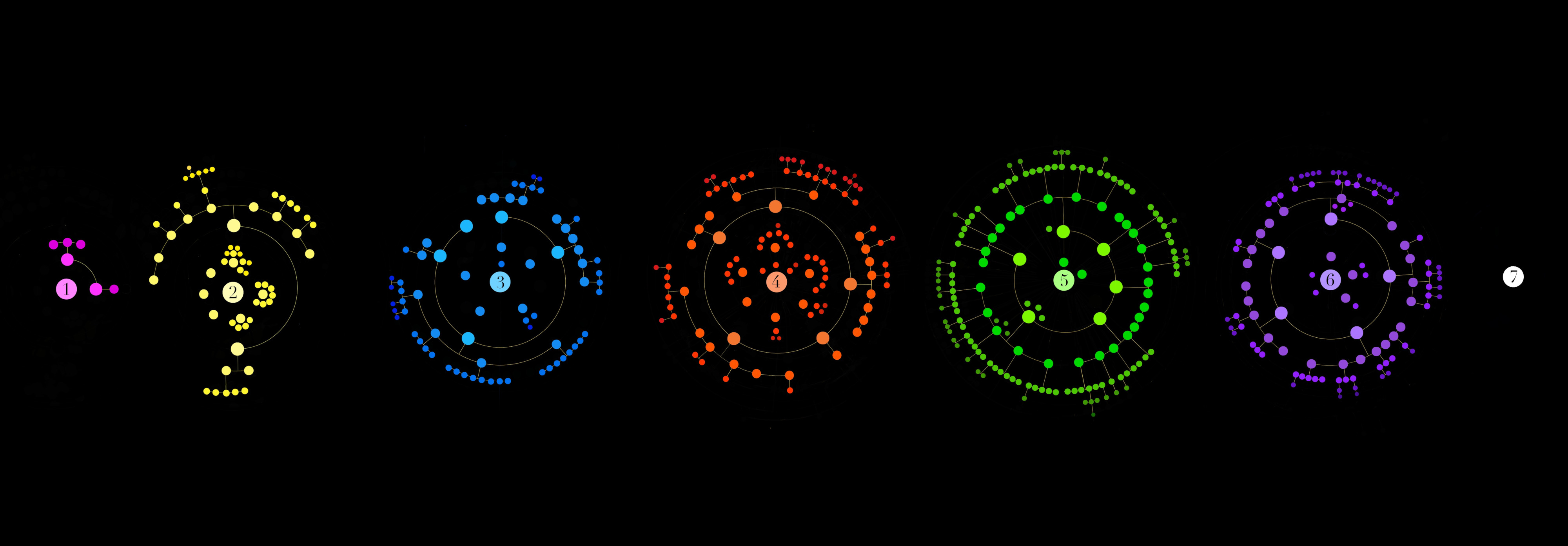
An artistic representation of the nonlinear structure of Wittgenstein's Tractatus Logico-Philosophicus.

Regarding the numbering that distinguishes the structure of the Tractatus Logico-Philosophicus, Wittgenstein explains in the footnote to the first remark: "The decimal figures as numbers of the separate propositions indicate the logical importance of the propositions, the emphasis laid upon them in my exposition. The propositions n.1, n.2, n.3, etc., are comments on proposition No. n; the propositions n.m1, n.m2, etc., are comments on the proposition No. n.m; and so on".
When the publisher Ludwig von Ficker, during negotiations for the publication of the text, raised the possibility of publishing the Tractatus without the complex numbering apparatus, Wittgenstein responded brusquely in a letter dated December 5, 1919: "The decimal numbers of my remarks absolutely must be printed alongside them, because they alone make the book perspicuous (übersichtlich) and clear: without the numbering it would be an incomprehensible mess".
Thus the Tractatus also became famous for its unavoidable numbering system accompanying the 526 propositions.
With the development of interactive computing devices, some scholars have transcended the linear sequence required by print to represent the book's structure and have created alternative schemes. For example, in 1996, computer scientist Jonathan Laventhol developed a hypertextual visualisation of the Tractatus using a program written in C on a Unix computer. This visualisation is available on the Tractatus Logico-Philosophicus Map website.
Computer engineer Pierre Bellon created an interactive Tractatus Tree that, once fully expanded by clicking on all the proposition numbers, has even more sophisticated effects; while the University of Iowa Tractatus Map, designed in the style of an underground network map, is fully laid out in front of the reader by default. And the Different Map of the Tractatus proposed in 2019 by computer scientist and philosopher David Strohmaier of the University of Cambridge has almost hypnotic results.
Apart from interactive visualisations, the numerous studies on the "tree structure" of the Tractatus proposed by Luciano Bazzocchi, and the debate they have sparked, are also worth mentioning.

SemanticArtGroup's work, Tractatus Cryptex, differs from all the above in its artistic rather than conceptual value. The closest precedent is mathematician Aaron Greicius's Tractatus Forest, created with Python-igraphic and Plotly: a forest of seven trees, corresponding to the seven main propositions, to which all other propositions are linked. Despite an evident structural similarity between Greicius's work and that of SemanticArtGroup, there are also some significant differences. For example, while Greicius's Forest maintains the same size for all the numbers of the Tractatus's propositions, the Cryptex marks the logical importance of the different propositions through a corresponding size, so that the circle representing proposition 2 is larger than that representing 2.1, and the circles for propositions with two, three, four, or five decimal places are progressively smaller. Another difference concerns the placement of propositions whose first decimal digit is 0. For example, the Forest, with regard to proposition 2, places the numbers representing both propositions 2.1 and propositions 2.01 on the same first concentric circle, while the Cryptex visually respects the greater logical proximity of 2.01 to proposition 2 compared to 2.1. Further differences could be highlighted, but the synopsis is not particularly important, since the Forest is an interactive conceptual graph for a non-sequential reading of the Tractatus, while SemanticArtGroup's Cryptex is an aesthetic work.
Yes, because, although rigorous in its logic, the Cryptex Tractatus is an artistic work more suited to the free associations it inspires than to rational conceptualizations. And at first glance, it looks like a firework appearing in a dark sky, or an eternal, shining braid, or the explosion of Wittgenstein's neural circuits when his mind was illuminated by the idea that "The world is everything that is the case". And every viewer is entitled to add the association that comes to mind when faced with this frieze of contemporary art…
About the author

More from the LWP's blog
Happy 2026 from the Ludwig Wittgenstein Project!
Cover image: "Ludwig Wittgenstein Skjolden Norge 2024" by Vadim Chuprina, CC BY-SA 4.0


